
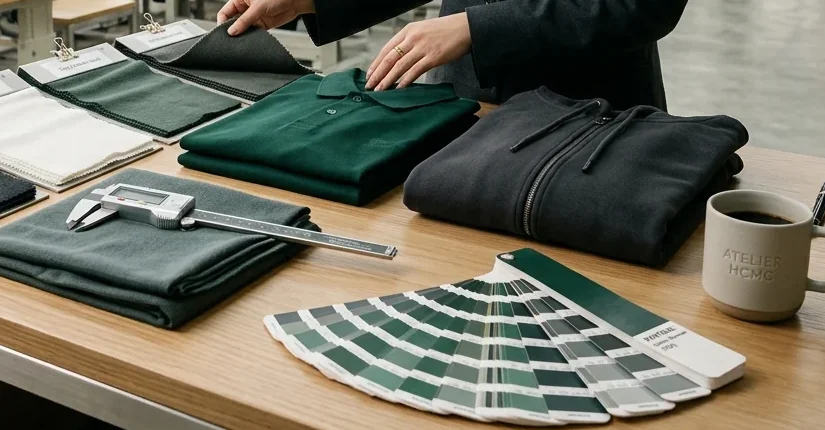
Vietnam has cemented its position as one of the world's most resilient and technically capable apparel manufacturing hubs. For North American, European, and Asia-Pacific apparel brands diversifying supply chains or scaling private-label programs, understanding the operational mechanics of Vietnam OEM (Original Equipment Manufacturing) is no longer optional. Whether you are sourcing circular-knit basics, flame-resistant industrial workwear, or technical seamless activewear, the difference between a profitable season and a margin-eroding delay comes down to factory tier matching, open-book costing, fabric lead-time control, and disciplined quality assurance.
This guide provides a senior-level operational blueprint for sourcing knitwear, workwear, and activewear in Vietnam. It covers regional factory clusters, realistic MOQ (Minimum Order Quantity) bands, FOB versus CMT cost structures, compliance frameworks, and a practical risk mitigation playbook designed for sourcing directors, production managers, and brand founders. If you are evaluating Vietnam as a core manufacturing base, start by reviewing our Vietnam sourcing overview and our dedicated apparel OEM manufacturing capabilities.
Why Vietnam Leads Global Apparel OEM Sourcing
Vietnam's apparel export sector consistently ranks among the top three globally, backed by over 6,000 garment and textile enterprises employing more than 2.5 million workers. Unlike emerging low-cost destinations that only handle basic cut-and-sew assembly, Vietnam offers a mature ecosystem capable of complex technical construction, multi-component trims, and strict international social compliance.
- Free Trade Agreement (FTA) Advantages: Vietnam is a signatory to the EVFTA (EU-Vietnam Free Trade Agreement), CPTPP (Comprehensive and Progressive Agreement for Trans-Pacific Partnership), and UKVFTA. Under these agreements, qualifying garments enjoy progressive tariff reductions down to 0%, provided Rules of Origin (often fabric-forward or yarn-forward depending on the agreement) are satisfied.
- Tariff Differential for US Importers: Compared to China, where Section 301 tariffs add 7.5% to 25% on top of standard MFN duty rates for many apparel categories, Vietnam-origin garments enter the United States under standard MFN rates, delivering immediate landed-cost savings.
- Skilled Technical Workforce: Vietnamese sewing operators have decades of experience producing for global athletic, outdoor, and workwear leaders. Efficiency rates on complex operations - such as ultrasonic bonding, 4-needle 6-thread flatlock stitching, and waterproof seam taping - rival or exceed legacy hubs.
- Expanding Domestic Fabric Base: While Vietnam historically relied heavily on imported fabrics from China, South Korea, and Taiwan, billions of dollars in foreign direct investment have built vertically integrated knitting, dyeing, and finishing mills across Dong Nai, Binh Duong, Tay Ninh, and northern industrial zones.
Regional Manufacturing Clusters and Factory Tiering
Selecting the right factory in Vietnam requires matching your product category and order volume to both the right geographic cluster and the right factory tier. Misalignment - such as placing a 1,500-piece activewear order with a 3,000-worker Tier-1 factory - almost always results in deprioritized production lines, slow sampling, and rigid pricing.
Geographic Apparel Clusters
- Southern Cluster (Ho Chi Minh City, Binh Duong, Dong Nai, Long An, Tay Ninh): The largest and most vertically integrated hub. Ideal for circular knitwear, technical activewear, denim, and complex multi-trim garments. Proximity to Cat Lai and Cai Mep-Thi Vai deep-water ports streamlines LCL and FCL ocean consolidation.
- Northern Cluster (Hanoi, Hai Phong, Nam Dinh, Thai Binh, Hung Yen): Historically strong in woven shirts, heavy industrial workwear, outerwear, and flat-knit sweaters. Proximity to Hai Phong and Lach Huyen ports, as well as land-border logistics corridors for specialized trims and fabrics from southern China, reduces raw material transit times by 5 to 7 days.
- Central Cluster (Da Nang, Hue, Quang Nam): A growing mid-cost alternative with lower labor turnover than Ho Chi Minh City. Well-suited for mid-volume woven trousers, uniforms, and standard knitwear programs.
Matching Your Volume to Factory Tiers
| Factory Tier | Headcount / Lines | Typical MOQ per Style | Strengths | Best Fit For |
|---|---|---|---|---|
| Tier 1 (Enterprise) | 1,500 - 10,000+ workers (30+ lines) | 5,000 - 20,000+ pcs | Vertical mill access, automated cutting, full WRAP/SA8000/Higg FEM, dedicated R&D labs | Global retail chains, high-volume replenishment programs |
| Tier 2 (Mid-Market Export) | 250 - 1,200 workers (6 - 25 lines) | 1,000 - 3,000 pcs | Strong technical skill, flexible colorway splits, direct owner engagement, BSCI/WRAP certified | Scaling DTC brands, specialty workwear, mid-size wholesale labels |
| Tier 3 (Agile Specialist) | 50 - 250 workers (2 - 6 lines) | 300 - 800 pcs | Rapid sampling, low MOQ flexibility, specialized machinery (seamless, flatlock, heavy canvas) | Emerging technical brands, capsule collections, test-and-repeat launches |
Category Deep Dive: Knitwear, Workwear, and Activewear
Each apparel category carries distinct machinery requirements, fabric supply chains, and MOQ constraints. Understanding these technical realities before issuing an RFQ (Request for Quotation) prevents unrealistic target pricing and wasted development cycles.
1. Knitwear (Circular Knit and Flat-Knit)
Vietnam excels in both cut-and-sew circular knitwear (jersey tees, French terry hoodies, pique polos, heavyweight fleece) and fully-fashioned flat-knit sweaters (3GG to 14GG Shima Seiki and Stoll machines). For circular knits, domestic Vietnamese mills can knit and dye 100% combed cotton, CVC (Chief Value Cotton), organic cotton, and bamboo-cotton blends locally. Standard dye-lot minimums at local mills range from 300 kg to 500 kg per color, which translates to roughly 800 to 1,500 T-shirts or 400 to 700 heavyweight hoodies per colorway.
For buyers seeking lower MOQs (300 to 500 pieces per style), sourcing stock-service greige or ready-to-dye fabrics from vetted local stockists allows faster turns without sacrificing GSM consistency or shrinkage control. Always specify fabric weight tolerance (+/- 5% GSM), spirality limits (maximum 3% to 5% after 3 washes), and enzyme or silicone wash recipes in your tech pack.
2. Industrial and Corporate Workwear
Workwear manufacturing in Vietnam covers heavy cotton duck canvas trousers, hi-visibility (ANSI/ISEA 107 and EN ISO 20471) jackets, flame-resistant (NFPA 2112 / EN ISO 11612) coveralls, and corporate hospitality uniforms. Workwear factories require heavy-duty twin-needle feed-off-the-arm machines, programmable bar-tackers for stress points, and automated pocket setters.
The primary bottleneck in workwear OEM is certified fabric and trim procurement. Inherently flame-resistant fabrics (such as aramid blends) or certified retro-reflective tapes (3M Scotchlite or equivalent) carry strict mill minimums of 1,000 to 3,000 meters per color and lead times of 35 to 50 days. Because workwear programs typically run for 2 to 5 years with minimal silhouette changes, smart buyers negotiate greige fabric reservations with the mill to cut repeat-order lead times from 90 days down to 45 days.
3. Technical Activewear and Athleisure
Activewear is one of Vietnam's fastest-growing high-margin segments, covering compression leggings, sports bras, moisture-wicking running tops, and bonded-seam performance shorts. Production demands specialized 4-needle 6-thread flatlock machines, coverstitch units, laser cutting, and heat-press bonding equipment. Fabric compositions typically involve 4-way stretch nylon-spandex (75/25 or 80/20) or recycled polyester-elastane blends with functional finishes (wicking, anti-odor, UPF 50+).
Activewear MOQs are governed by synthetic yarn and dyeing minimums: typically 500 to 1,000 pieces per style and 300 to 500 pieces per colorway when using nominated Korean, Taiwanese, or Tier-1 Vietnamese synthetic mills. Critical quality parameters include seam elasticity recovery, gusset construction accuracy, heat-transfer logo wash durability (minimum 20 to 30 home launderings without cracking), and colorfastness to perspiration (ISO 105-E04 Grade 4.0 minimum).
Open-Book Costing: FOB vs. CMT Structures
Experienced apparel buyers insist on open-book costing (also called a Cost Breakdown or CBD) rather than accepting opaque lump-sum quotes. Understanding whether to contract on a CMT (Cut, Make, Trim) or FOB (Free On Board) basis directly impacts your unit economics and working capital.
- CMT (Cut, Make, Trim): The buyer sources and pays for fabric and major trims directly from nominated mills, then ships them to the Vietnamese factory. The factory charges only for cutting, sewing, pressing, packing, and local overhead. CMT is ideal for brands with proprietary fabrics, strict mill rebates, or high-volume programs exceeding 10,000 units per style.
- FOB (Free On Board - Port of Ho Chi Minh City or Hai Phong): The factory procures all fabrics and trims, manages production, and delivers export-cleared goods onto the vessel at the named Vietnamese port. FOB transfers material yield risk and local procurement coordination to the factory, making it the preferred model for most mid-market brands ordering 500 to 10,000 pieces per style.
Illustrative Open-Book FOB Cost Breakdown (Men's 280 GSM Organic Cotton Hoodie - 1,500 pcs)
| Cost Component | Calculation Basis | Unit Cost (USD) | % of FOB |
|---|---|---|---|
| Main Fabric (280 GSM French Terry) | 1.45 meters x $4.20/m (incl. 5% wastage) | $6.09 | 43.5% |
| Rib Fabric (2x2 Cotton/Spandex Rib) | 0.22 meters x $4.80/m | $1.06 | 7.6% |
| Trims & Accessories | Drawcord, eyelets, woven main/care labels, hangtag, polybag | $1.15 | 8.2% |
| CM (Cut & Make Labor) | 28 SAM (Standard Allowed Minutes) x $0.13/min | $3.64 | 26.0% |
| Garment Wash & Finishing | Silicone enzyme wash + steam pressing | $0.65 | 4.6% |
| Testing, QC & Local Logistics | In-house lab check, export carton, drayage to Cat Lai port | $0.41 | 2.9% |
| Factory Overhead & Margin | ~7.5% net margin on direct costs | $1.00 | 7.2% |
| Total FOB Ho Chi Minh City | Open-book verified | $14.00 | 100.0% |
Sourcing Tip: Never negotiate a factory's CM rate below sustainable living-wage thresholds. Aggressive squeezing on labor rates forces factories to cut corners on stitch density (SPI), skip inline pressing, or subcontract orders to uncertified workshops. Instead, optimize cost through marker efficiency (fabric utilization), trim standardization across styles, and dye-lot consolidation.
Realistic Production Lead Times and Critical Path Calendar
Underestimating lead times is the single most common cause of missed retail launch windows. A realistic end-to-end Critical Path (Time and Action Calendar) for a first-time Vietnam apparel OEM order using custom-dyed fabric runs 90 to 110 days from PO confirmation to vessel departure.
- Days 1 - 10 (Tech Pack Lock & Lab Dips): Finalize graded measurement specs, Bill of Materials (BOM), and submit Pantone references. Mill produces lab dips (A/B/C shades) for buyer approval.
- Days 11 - 25 (Proto & Fit Sample): Factory constructs fit samples in substitute or base fabric. Buyer conducts fit session and issues technical comments.
- Days 26 - 50 (Bulk Fabric Production & Transit): Custom knitting/weaving and dyeing take 25 to 35 days domestically, or 35 to 45 days if imported from Taiwan, South Korea, or China (including customs clearance).
- Days 51 - 60 (Pre-Production Sample - PP Sample): Factory cuts and sews PP samples using actual bulk fabric and actual bulk trims. No bulk cutting is permitted until the PP sample is signed off in writing.
- Days 61 - 85 (Bulk Cutting, Sewing, Washing & Finishing): Inline QC (DUPRO) is conducted at 15% to 25% completion to catch systemic stitching or measurement drift early.
- Days 86 - 92 (Final Random Inspection - PSI): Independent ISO 2859-1 AQL 2.5 inspection is performed when 100% of garments are produced and at least 80% are packed in export cartons. Learn more about our 6-gate ISO 2859-1 QA/QC framework.
- Days 93 - 100 (Export Customs, Consolidation & Vessel Departure): Goods move to Cat Lai or Hai Phong port, clear export customs, and load onto the vessel.
Social, Environmental, and Chemical Compliance
Global retailers and customs authorities enforce strict compliance requirements. Before issuing a purchase order, verify that your Vietnamese factory holds active, unexpired certifications from accredited third-party auditing bodies - never rely on expired PDFs or self-declarations.
- Social Compliance: WRAP (Worldwide Responsible Accredited Production - Gold or Platinum), amfori BSCI (Grade A or B), SA8000, and SMETA / Sedex 4-Pillar are the standard benchmarks for US and EU buyers. Audit reports must verify zero forced labor, legal overtime limits (Vietnam Labor Code caps), fire safety, and social insurance contributions.
- Chemical and Material Safety: OEKO-TEX Standard 100 (Class I for babywear, Class II for direct skin contact) ensures fabrics and trims are free from harmful azo dyes, formaldehyde, phthalates, and heavy metals. For EU buyers, REACH compliance is mandatory; for US children's apparel, CPSIA lead and phthalate testing is legally required.
- Sustainability & Recycled Claims: GRS (Global Recycled Standard) and GOTS (Global Organic Textile Standard) require Transaction Certificates (TCs) issued for each specific shipment lot - not just a Scope Certificate at the factory level.
- US UFLPA Traceability: For cotton apparel entering the United States, importers must maintain a complete chain-of-custody dossier (yarn invoices, spinning mill certificates, fabric mill packing lists, and origin declarations) proving zero Xinjiang cotton content under the Uyghur Forced Labor Prevention Act.
Pre-Production Risk Mitigation Playbook
Even top-tier factories encounter production variance if technical controls are loose. Implement these five non-negotiable safeguards on every Vietnam OEM order:
- Fabric 4-Point Inspection & Shade-Band Testing: Require the factory to inspect at least 10% of incoming fabric rolls using the ASTM D5430 4-point system (maximum 20 to 24 penalty points per 100 square yards) and cut blanket shade bands across roll widths to prevent center-to-selvedge color variation.
- Shrinkage & Pattern Compensation: Wash-test three swatches from every bulk dye lot before cutting. If bulk fabric shrinks 4.5% instead of the 3.0% assumed in the pattern, adjust cutting patterns immediately rather than discovering out-of-spec garments at PSI.
- Golden Sample Sealing: Seal two identical approved PP samples with tamper-evident tags - one stays on the factory sewing floor as the Golden Sample, and one is held by your buying office or QC inspector.
- Trim Buffer Allocation: Order 3% to 5% extra woven labels, zippers, buttons, and hangtags. A missing $0.08 care label can delay a $100,000 container by two weeks.
- Bilingual PO Terms & Quality Clauses: Attach an explicit AQL 2.5 acceptance clause, delivery penalty structure, and non-subcontracting clause to every purchase order.
Step-by-Step Factory Qualification Checklist
- Define Technical Package: Complete flat sketches, graded spec sheet (XS-XXL), BOM with GSM/composition, stitch-per-inch (SPI) callouts, and packaging manual.
- Shortlist 3 to 5 Vetted Factories: Filter by product specialty, machine park (flatlock, seam-sealing, heavy-duty bar-tack), active compliance certificates, and MOQ alignment.
- Conduct On-Site Technical Audit: Verify actual sewing lines, needle-detection protocols, fabric warehouse humidity control, and in-house QA staffing.
- Evaluate Open-Book Quotations: Compare normalized CBDs line by line (fabric yield, CM rate, trim pricing, wash cost).
- Execute Sample Validation: Approve lab dips, fit sample, size-set sample, and bulk-fabric PP sample sequentially.
- Enforce 6-Gate Quality Control: Monitor incoming materials, PPM, inline DUPRO, final AQL 2.5 PSI, and container loading supervision.
Ready to benchmark factory-direct FOB pricing or audit qualified Vietnam knitwear, workwear, or activewear manufacturers? Submit your RFQ and tech pack to receive a structured open-book sourcing comparison from our on-the-ground engineering team.
Frequently Asked Questions
What is the realistic minimum order quantity (MOQ) for apparel OEM in Vietnam?
For Tier-2 export factories, realistic MOQs are 800 to 1,500 pieces per style (split across 2 to 3 colorways) for knitwear and activewear, and 1,000 to 2,000 pieces per style for specialized workwear. Agile Tier-3 specialist factories can support 300 to 500 pieces per style when utilizing stock-service fabrics, though unit FOB prices will be 10% to 18% higher than volume-tier runs.
Should I use CMT or FOB pricing for my first Vietnam apparel order?
FOB is strongly recommended for first-time and mid-market buyers. Under FOB, the factory assumes responsibility for fabric consumption yield, local trim sourcing, customs clearance of imported fabrics, and delivery to the Vietnamese port. CMT only makes financial sense once your volume is large enough to negotiate direct mill contracts and you have dedicated supply chain staff managing raw material logistics.
How do I ensure my Vietnam cotton garments comply with US UFLPA rules?
Specify non-Chinese cotton origins (such as US Supima, Australian, Brazilian, or Indian cotton) in your purchase order and require a full documentary trail: cotton bale origin certificates, spinning mill invoices, knitting/weaving mill delivery notes, and garment factory receiving logs. Never accept verbal assurances from a trading intermediary.
Can Vietnamese factories handle custom technical fabrics like waterproof membranes or FR textiles?
Yes. Vietnam's technical apparel factories routinely process 3-layer waterproof breathable membranes, Pertex, Cordura, Polartec, and certified flame-resistant fabrics. While many specialty performance fabrics are nominated from mills in Taiwan, South Korea, or Japan, Vietnamese factories have mature bonded-warehouse customs procedures to import these materials duty-free for export garment production.
What payment terms are standard when working directly with Vietnamese apparel factories?
For new relationships, the standard structure is a 30% deposit via T/T (wire transfer) upon PO confirmation (to trigger fabric booking) and 70% balance against a clean Pre-Shipment Inspection (PSI) report and copy of the Bill of Lading. For orders exceeding $50,000, an irrevocable Letter of Credit (L/C at sight) is widely accepted by Tier-1 and Tier-2 factories.

Authored and verified from live Vietnam factory audits, direct FOB/CMT apparel & multi-sector sourcing execution, and international B2B export marketing campaigns in Ho Chi Minh City.
