
Over the past five years, the China+1 sourcing strategy has evolved from a boardroom contingency plan into an operational imperative for North American, European, and Australian importers. Rising geopolitical tariff exposure, freight volatility, and single-country concentration risks have accelerated capital and order migration into Southeast Asia. Among all regional alternatives, Vietnam stands out for its rare combination of political stability, deep-water port infrastructure, 16 active Free Trade Agreements, and multi-sector manufacturing depth.
While apparel and electronics often dominate headlines, three of Vietnam's highest-opportunity B2B export pillars for mid-market and enterprise buyers are wood furniture and homewares, industrial and retail packaging, and processed agri-food ingredients. This guide delivers an executive-level operational playbook for transitioning multi-sector sourcing into Vietnam - covering industrial clusters, compliance frameworks (FSC, EUDR, BRCGS, HACCP, FDA), MOQ and lead-time benchmarks, open-book landed cost modeling, and a 90-day transition roadmap. Explore our broader Vietnam sourcing hub and dedicated multi-sector manufacturing capabilities to align your category strategy.
Why Vietnam Is the Premier China+1 Multi-Sector Hub
A successful China+1 shift requires more than low labor costs; it demands reliable industrial utilities, container shipping frequency, and export-experienced factory management. Vietnam delivers on all three fronts:
- Direct Deep-Water Port Connectivity: Cai Mep-Thi Vai (Southern Vietnam) and Lach Huyen (Northern Vietnam) accommodate mother vessels sailing directly to Los Angeles, Long Beach, Savannah, Rotterdam, and Hamburg without transshipment delays in Singapore or Hong Kong.
- Tariff and Trade Architecture: Under EVFTA, UKVFTA, CPTPP, and RCEP, Vietnam-origin furniture, packaging, and processed foods enjoy preferential duty access. For US importers, Vietnam avoids Section 301 punitive tariffs that add up to 25% on Chinese-origin furniture, cabinets, and packaging components.
- Mature Industrial Park Ecosystem: Modern industrial zones in Binh Duong, Dong Nai, Long An, Binh Dinh, Hai Phong, and Bac Ninh provide stable three-phase power, wastewater treatment plants, and bonded warehouse facilities.
- Abundant Domestic Raw Materials: Unlike categories that depend entirely on imported components, Vietnam possesses vast domestic plantations of FSC-certified acacia and rubberwood, a rapidly expanding paperboard and pulp recycling base, and world-leading agricultural output in coffee, cashews, black pepper, coconut, and tropical fruits.
Sector 1: Wood Furniture and Homewares
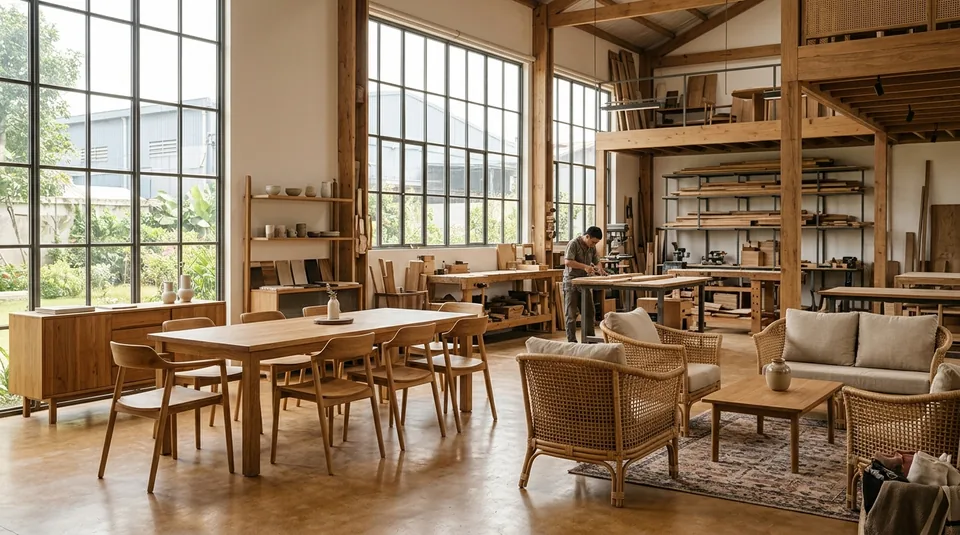
Vietnam is the second-largest wood furniture exporter in the world and the leading supplier to the United States. The sector is anchored by two primary clusters: the Southern Cluster (Binh Duong and Dong Nai), which specializes in indoor dining, bedroom, upholstery, and engineered-wood flat-pack furniture, and the Central Cluster (Binh Dinh / Quy Nhon), which dominates outdoor acacia and eucalyptus garden furniture.
Materials, Moisture Control, and Technical Specifications
Domestic Vietnamese plantation timber - primarily acacia, rubberwood, and eucalyptus - offers an attractive cost-to-durability ratio, while higher-end collections frequently import kiln-dried American white oak, ash, walnut, or European beech. The single most critical technical risk in Vietnam wood furniture is moisture content (MC) control. Because Vietnam has a tropical monsoon climate, wood that is not properly kiln-dried will warp, split, or crack once shipped to dry heated interiors in North America or Europe.
- Target Kiln-Dried Moisture Content: Specify 8% to 10% MC for indoor furniture destined for North America and Europe, and 10% to 12% MC for outdoor garden furniture.
- Finishing Systems: Top factories operate dust-free automated spray lines, UV-cured lacquer tunnels, and multi-step NC (nitrocellulose) or water-based PU (polyurethane) finishing chambers.
- Flat-Pack and Drop-Test Engineering: For e-commerce and omni-channel retail buyers, require ISTA 3A or ISTA 6-Amazon packaging drop-test validation using 5-ply double-wall BC-flute export cartons with high-density corner protectors and honeycomb dividers.
Furniture Compliance: FSC, CARB/EPA, and EUDR
Regulatory scrutiny on timber products has tightened sharply. Importers must verify three core compliance pillars before placing a purchase order:
- FSC Chain of Custody (FSC 100% or FSC Mix): Verify the factory's active FSC license code in the public FSC database and ensure the FSC claim appears on both the commercial invoice and packing list.
- Formaldehyde Emissions (CARB Phase 2 / EPA TSCA Title VI): Mandatory for all composite wood products (MDF, particleboard, plywood) entering the United States. Require third-party TPC (Third-Party Certifier) lab test certificates.
- EU Deforestation Regulation (EUDR): For shipments entering the European Union, timber suppliers must provide precise GPS polygon geolocation coordinates of the harvest plots proving the wood was harvested from deforestation-free land after December 31, 2020.
Sector 2: Industrial and Retail Packaging
As brands relocate finished-goods manufacturing to Vietnam, or seek tariff-free packaging for North American and European distribution centers, Vietnam's packaging sector has scaled rapidly. Key clusters are concentrated in Ho Chi Minh City, Long An, Binh Duong, and Bac Ninh.
Core Product Capabilities
- Corrugated Shipping Cartons & Retail Displays: High-speed 5-ply and 7-ply corrugators with 4-to-6 color flexo printing, die-cutting, and Edge Crush Test (ECT 32 to ECT 44) or Bursting Strength (Mullen) certification.
- Luxury Rigid Boxes & Folding Cartons: Offset litho printing (Heidelberg and Komori presses), foil stamping, spot UV, embossing, and magnetic-closure rigid boxes for cosmetics, electronics, and gourmet gifting.
- Flexible Packaging & Stand-Up Pouches: Rotogravure and digital printing for multi-layer barrier pouches (PET/AL/PE, MOPP/VMPET/PE), spout pouches, and recyclable mono-material PE pouches for food, pet care, and household products.
- Molded Fiber & Sustainable Packaging: Bagasse (sugarcane) and bamboo-pulp molded trays, cup carriers, and protective electronics inserts replacing expanded polystyrene (EPS) foam.
Tooling, MOQs, and Quality Standards
Packaging MOQs are driven by print setup and material run minimums. Custom corrugated cartons typically require 1,000 to 3,000 units per size; offset folding cartons require 3,000 to 5,000 units; and rotogravure flexible pouches require 10,000 to 20,000 units per SKU (plus cylinder engraving fees of $150 to $250 per color). For food-contact packaging, insist on BRCGS Packaging Materials or ISO 22000 certification, plus FDA 21 CFR or EU 10/2011 migration test reports.
Sector 3: Processed Agri-Food and Specialty Ingredients
Vietnam is an agricultural powerhouse transitioning rapidly from raw commodity exports to value-added, retail-ready, and foodservice-grade processed foods. Key sourcing regions include the Central Highlands (Robusta and Arabica coffee, black pepper, macadamia), the Southeast (Binh Phuoc, Dong Nai) (cashew nuts, cacao), and the Mekong Delta (rice, rice noodles, coconut milk/water, pangasius, dried mango, dragon fruit, and jackfruit).
Food Safety and Export Regulatory Compliance
Agri-food sourcing carries zero margin for regulatory error. A single container detained by US FDA or EU RASFF (Rapid Alert System for Food and Feed) can result in total cargo destruction and import alert blacklisting. Every qualified Vietnamese food processor must maintain:
- GFSI-Recognized Food Safety Systems: HACCP, ISO 22000, BRCGS Food Safety, or FSSC 22000.
- US FDA Compliance: Valid FDA Facility Registration Number, US Agent designation, Prior Notice filing before vessel arrival, and complete FSVP (Foreign Supplier Verification Program) hazard analysis documentation.
- Chemical and Microbiological Testing: Pre-shipment lab certificates (COA - Certificate of Analysis) from ISO 17025 accredited labs (such as Eurofins, SGS, or Intertek Vietnam) verifying aflatoxin limits, heavy metals, pesticide Maximum Residue Limits (EU MRLs), Salmonella/E. coli absence, and moisture/water activity (Aw) stability.
- Phytosanitary and Origin Certificates: Official Phytosanitary Certificate issued by Vietnam's Plant Protection Department, plus Certificate of Origin (C/O Form EUR.1 for EU or CPTPP form) to claim duty-free entry.
Cross-Sector Comparison Matrix: MOQ, Lead Time & Compliance
| Parameter | Wood Furniture & Homewares | Industrial & Retail Packaging | Processed Agri-Food |
|---|---|---|---|
| Primary Clusters | Binh Duong, Dong Nai, Binh Dinh | HCMC, Long An, Binh Duong, Bac Ninh | Mekong Delta, Central Highlands, Binh Phuoc |
| Typical MOQ | 1 x 40'HC container (can mix 3 - 5 SKUs) | 1,000 - 3,000 (cartons); 10,000+ (pouches) | 1 x 20'DC or 5 - 10 MT (bulk/private label) |
| First-Order Lead Time | 45 - 65 days (incl. kiln drying & finishing) | 20 - 35 days (incl. tooling/cylinders) | 25 - 40 days (incl. lab COA & phyto) |
| Core Certifications | FSC CoC, CARB P2 / EPA TSCA, BSCI, EUDR | BRCGS Packaging, ISO 9001, FSC Mix | HACCP, BRCGS Food, FSSC 22000, FDA, Halal |
| Primary QC Risk | Wood moisture warping, finish scratches, drop-test failure | Color delta-E drift, glue delamination, ECT crush failure | Aflatoxin/pesticide MRLs, moisture clumping, seal leaks |
Open-Book Landed Cost Modeling and Container Optimization
When transitioning from China to Vietnam, comparing factory ex-works (EXW) quotes alone is misleading. Senior sourcing teams evaluate total Landed Duty-Paid (LDP) cost per sellable unit, factoring in container cube utilization, ocean freight, and import tariffs.
- Furniture (Cube-Out Cargo): A 40' High Cube (40'HC) container holds roughly 66 to 68 CBM of usable space. Redesigning a dining table or chair from assembled to knock-down (KD) flat-pack can increase container loadability from 180 units to 420 units - cutting ocean freight cost per unit by more than 55%.
- Packaging (Mixed Cube/Weight): Flat-packed corrugated cartons and rigid boxes ship efficiently in 40'HC containers, whereas rigid assembled boxes ship "air" and are rarely economical over ocean freight unless nested.
- Agri-Food (Weight-Out Cargo): Dense products like roasted cashews, green coffee beans, or canned coconut milk hit maximum payload weight (20 to 24 metric tons) inside a 20'DC container before filling the volume. Always calculate freight per metric ton rather than per CBM.
Operational Insight: Multi-sector buyers sourcing across two or three categories in Southern Vietnam can consolidate LCL shipments through a single Vietnam buying office into mixed FCL containers at Cat Lai port, eliminating destination CFS deconsolidation fees and reducing transit damage.
Multi-Sector Supply Chain Risks and Mitigation Playbook
Diversifying into Vietnam introduces operational nuances that differ from mature Chinese clusters. Proactively address these five risks:
- Monsoon Humidity and Mold Damage: From May to November, relative humidity in Southern Vietnam regularly exceeds 85%. Mandate kiln-dried pallets (ISPM-15 heat-treated, MC < 18%), container floor moisture checks prior to loading, and calcium chloride container desiccants (minimum 8 to 12 poles per 40'HC).
- Raw Material Seasonality: Cashews, coffee, and tropical fruits follow strict harvest windows. Lock forward pricing or raw material buffer contracts during peak harvest months to avoid off-season spot price spikes of 15% to 30%.
- Sub-Tier Outsourcing: Some mid-size furniture and packaging factories quietly subcontract wood carving, metal leg welding, or lamination to uncertified local workshops. Enforce strict non-subcontracting clauses and conduct unannounced inline inspections.
- Port and Tet Holiday Congestion: Vietnamese factories close for 10 to 14 days during Lunar New Year (Tet, late January or February), and worker return rates can lag for another week. Book Q1 production capacity and vessel space at least 60 days before Tet.
- Regulatory Documentation Errors: A single typo on a Phytosanitary Certificate, FSC invoice claim, or Certificate of Origin can trigger customs holds at destination ports. Require pre-shipment document drafts for buyer approval 5 days before vessel cut-off.
Step-by-Step 90-Day China+1 Transition Roadmap
- Days 1 - 20 (Portfolio Audit & RFQ Normalization): Identify SKUs with highest tariff exposure or margin upside. Prepare standardized technical specs, target FOB prices, and compliance checklists.
- Days 21 - 45 (Factory Discovery & On-Site Audits): Shortlist 3 to 5 direct manufacturers per category. Conduct physical factory audits verifying machinery, active certifications (FSC, BRCGS, HACCP), and financial stability.
- Days 46 - 70 (Golden Sample & Lab Validation): Produce pre-production samples, run third-party lab tests (ISTA drop tests, CARB/EPA, FDA/MRL COAs), and lock open-book cost breakdowns.
- Days 71 - 90 (Pilot Container Execution): Place an initial 20'DC or 40'HC trial order with strict inline QC, AQL 2.5 final inspection, and container loading supervision before scaling to full dual-sourcing volume.
Planning a multi-sector China+1 expansion into Vietnam furniture, packaging, or agri-food? Submit your product specifications and volume targets to receive audited factory shortlists and open-book FOB benchmarks.
Frequently Asked Questions
Can Vietnam completely replace China for furniture, packaging, and agri-food?
For wood furniture and processed tropical agri-food, Vietnam is already a primary global leader capable of absorbing 100% of a buyer's volume. For specialized packaging requiring ultra-complex tooling or rare specialty films, a dual-sourcing China+1 model (moving 40% to 70% of core SKUs to Vietnam while retaining niche tooling in China) delivers the optimal balance of tariff savings and supply resilience.
How do Vietnam furniture prices compare to China on a landed basis?
Factory FOB prices for solid acacia and rubberwood furniture in Vietnam are typically 5% to 12% lower than equivalent Chinese factories. Once you factor in the elimination of US Section 301 tariffs (up to 25%), total landed duty-paid savings for US importers frequently reach 18% to 30%.
What is the biggest mistake importers make when sourcing agri-food from Vietnam?
Relying on small trading brokers who aggregate raw materials from unverified farms without batch traceability. When EU or US customs test for pesticide MRLs or aflatoxin, brokers cannot produce farm-level Corrective Action Plans. Always contract directly with BRCGS/HACCP-certified processing plants that control their own raw material intake testing.
How long does it take to qualify a new packaging supplier in Vietnam?
Qualification takes 3 to 5 weeks from RFQ to approved pre-production sample. Corrugated and folding carton tooling (cutting dies and print plates) takes 5 to 7 days, while rotogravure cylinders for flexible pouches take 10 to 14 days.
Do I need a local entity in Vietnam to buy directly from factories?
No. Foreign companies can issue purchase orders directly to Vietnamese export-licensed factories and pay via international T/T or L/C in USD. However, partnering with an on-the-ground Vietnam buying office ensures rigorous factory vetting, open-book price negotiation, and 6-gate quality control without the overhead of incorporating a local subsidiary.

Authored and verified from live Vietnam factory audits, direct FOB/CMT apparel & multi-sector sourcing execution, and international B2B export marketing campaigns in Ho Chi Minh City.
